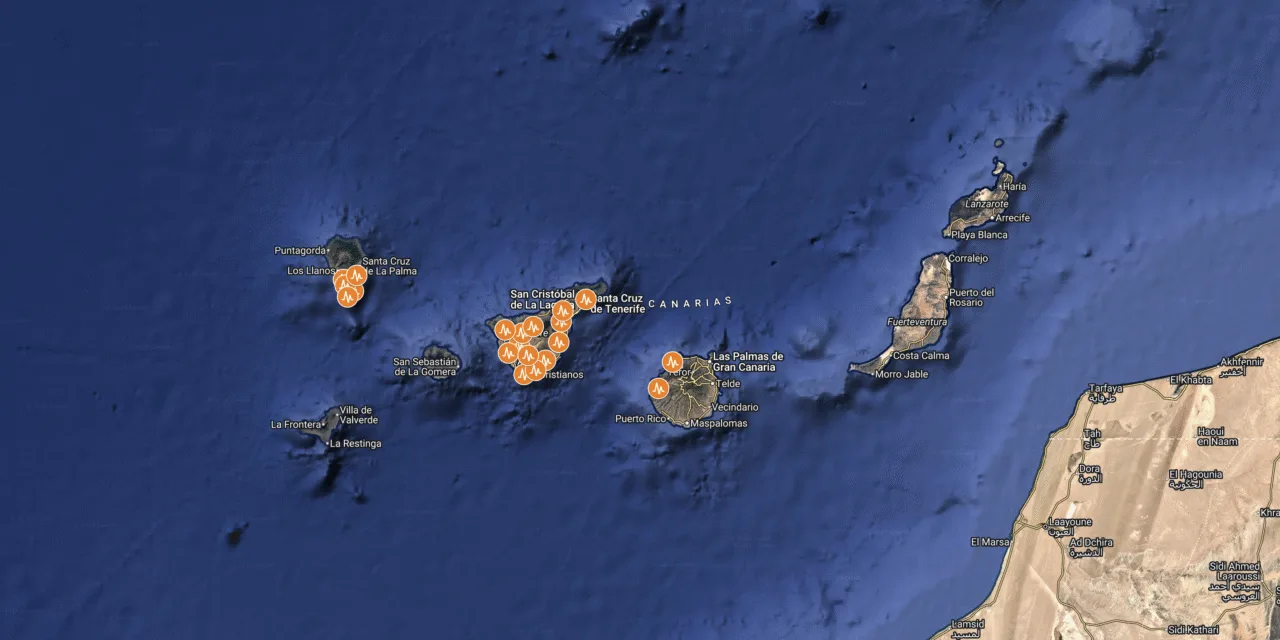
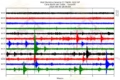
Tenerife, Canary Islands – Over 90 low-magnitude earthquakes were recorded beneath Mount Teide in Tenerife on Saturday, August 30, 2025. These tremors occurred within a short timeframe, between 5:14 p.m. and 6:26 p.m., and were detected by the Canary Islands Volcanological Institute (Involcan) as part of its ongoing seismic surveillance program.
|
----- Google provide a way for you to
|
Despite this cluster of tremors, Involcan has assured the public that there are no signs of an imminent eruption and has ruled out any increased likelihood of volcanic activity in the short or medium term.
 Understanding Seismic Swarms

Involcan explained that these are “volcano-tectonic events,” caused by the fracturing of rocks within the island’s volcanic system. The institute considers this episode to be part of the natural geodynamic behavior of the Teide-Pico Viejo complex and does not indicate magma is currently moving toward the surface.
Seismic swarms—groups of earthquakes occurring close together in time and location—are relatively common in the Canary Islands, particularly around Tenerife and La Palma. Since June 2017, Tenerife has experienced over 120 similar swarms, typically involving small, low-intensity quakes. These tremors are usually linked to pressurization processes within the volcanic-hydrothermal system beneath Mount Teide. Supporting evidence for this includes:
-
Diffuse CO2 emissions measured around the Teide crater.

-
Minor ground deformation, detected by GPS and satellite since 2024, particularly in the northeast of the Teide-Pico Viejo complex.
The August 30 swarm is considered consistent with this established pattern.
Mount Teide and Volcanic Monitoring
Mount Teide, standing at 3,718 meters, is the highest point in Spain and is classified as a dormant but active volcano, with its last eruption occurring in 1909 (Chinyero vent). Involcan continuously monitors volcanic activity across the islands using a network of seismic, geochemical, and geodetic instruments, tracking:
-
Seismic activity (tremors and swarms)
-
Volcanic gas output (CO2, SO2)
-
Ground deformation
-
Thermal anomalies
These systems provide crucial early warning capabilities in the unlikely event of an evolving magmatic intrusion.
No Change in Alert Level
As of September 1, 2025, Tenerife’s volcanic alert status remains at green level, signifying “normal volcanic activity.” This means residents and visitors should not be concerned about an increased risk of eruption. In contrast, La Palma remains under a yellow alert following the 2021 eruption of Cumbre Vieja, with authorities regularly reviewing and updating risk maps as part of regional volcanic preparedness.
Involcan continues to promote public awareness while reassuring residents and visitors that the situation at Mount Teide is stable.